Realism

Published on by Catherine Toulsaly

Comet 46P Wirtanen on 12 December 2018 (cropped)
PIA22970-1041-Asteroid2003SD220-20181221

I read that Consciousness is the one that is not real, and the Universe is alone, dancing with the stars... 


To put it into perspective, we are 93 million miles away from the Sun. A couple of close encounters have happened lately with the passing of a comet at 7.1 million miles away and an asteroid at 1.8 million miles away. On the other end of the spectrum, Voyager 2 has found itself beyond the heliosphere at more than 11 billion miles away. Distances are everything. They help us expand our horizons by adding new objects to our Consciousness. Slipping out of the reach of the solar winds, Voyager 2 reminds me of the foretelling picture of the missionary lifting the sky veil in the footsteps of the greatest 15th century’s explorers sailing off the seas.


Universum

Instead of horizons where Earth and Sky touch each other, the heliopause is the gateway to the interstellar space. That's where we cross over the four corners of reality determined by new properties that already exist prior to our discovery. Beyond our bubble of dynamic solar winds, elements of reality are waiting to be measured and their properties to be determined.  


If the Universe were a macro-state, new comets and asteroids would be "hidden variables" coming into play, whose measurements are pieces of a puzzle. Consciousness is set to understand whether those encounters are the result of true randomness or the outcome of a deterministic pattern. The first interstellar object ever to be detected, Oumuamua, is a perfect example of an element of reality that seemed to come right out of the realm of infinite possibilities. Its discovery last year in the data from the Pan-STARRS1 telescope - involved with its twin telescope Pan-STARRS2 in surveying the sky in the search for near-earth asteroids - made it an actual entity, a macroscopic object whose properties have yet to be determined. It is fascinating to think that we do not know Oumuamua’s system of origin given how difficult it is to retrace its footsteps but we do know that it has an existence independent of our measurement process.  Realism is when properties of objects have a definite value even if we don’t measure them.  

A2017U1 5gsmoothWHT enhanced

Time seems so slow when launching a spacecraft to a faraway destination. It took 41 years for Voyager 2 to reach the outskirts of the heliosphere across time and Space. We're told that time is a convenient tool to view the Universe and that the Universe might be a "global coordination" whose underlying structure is nonlocal across time and Space. But like a House of cards made of two colors, one Time and the other Space, wouldn't the entire House come tumbling down if Space is removed? And if we only knew of the Universe's boundary conditions, would the beginning and the end be superposed on each other in a chain of manifold cycles run through by a complex information system that reboots at every transition stage? Time is perceived through infinite ontic states that carry information from the past to the future. 

...the actual initial state of the world is chosen arbitrarily and the allowed kinematical set is then simply equal to the maximal set of states into which this state can be taken by allowed dynamical evolutions

Emily Adlam

How to conciliate macro-realism with the quantum world where “the later measurement results depend directly on earlier measurement settings and outcomes without being mediated via information carried forward in the state”? Could the Universe as a whole act as a quantum system? According to Helmut Fink and Hajo Leshcke, “Since the universe is the total domain of physical experience, it cannot be copied, not even in a thought experiment. Therefore, a quantum state of the whole universe can never be made accessible to empirical test. Hence the existence of such state is only a metaphysical idea”. Why then is quantum mechanics what it is if it has no bearing on our reality?  One wonders how spooky actions at a distance translate in a chain of macroscopic events. Can we imagine a cosmological scenario in which the Universe is made of an infinite number of microstates linked by hidden variables that are not conceivable yet? 

Such variables evolve in so called “hidden time”, which is not equivalent to physical time as well. Hidden time is mathematical notion only. Then, elementary events are “sewing” points between hidden time and physical time.

Kurakin P. V.

In theory the definition of a physical Universe as “empirically accessible in principle”  does not preclude any future observation, dependent upon the technological advance of measurement-device techniques, of interstellar objects such as Oumuamua. The information carried by Oumuamua has now become an observational evidence, a window into what lies beyond our solar system.  Given the approximated number density of interstellar objects within the Earth orbit, one wonders why Oumuamua and not any other object was the first to be spotted. Its elongated, or maybe flat oval, shape reminds me the story of the “long white cloud” named Aotearoao that was revealed to the great Maori seaferers above the location of New-Zealand shores. 

In my own narration of an action at distance, I imagine a spacetime event such as the passing of Oumuamua through our solar system to influence across time and space its sequential manifestation in another star system. Sprinkled with solar wind dust it would trigger the interest of some far away planet into the whereabouts of our own solar system. 

The dynamics which we will derive can be regarded as a process of “cosmological accretion” or “growth”. At each step of this process an element of the causal set comes into being as the “offspring” of a definite set of the existing elements – the elements that form its past. The phenomenological passage of time is taken to be a manifestation of this continuing growth of the causet. Thus, we do not think of the process as happening “in time” but rather as “constituting time”, which means in a practical sense that there is no meaningful order of birth of the elements

D. P. Rideout and R. D. Sorkin

What is the underlying reality that quantum states represent knowledge about? Maybe time, as we experience it in multifold ways through conscious and unconscious forms, “varies along with the distribution of matter”.

Realism

Earthrise

Published on by Catherine Toulsaly

NASA-Apollo8-Dec24-Earthrise

December 2018 marks the fiftieth anniversary of Earthrise, a photograph taken by Astronaut Bill Anders aboard Apollo 8. Earthrise symbolizes the dramatic widening of human consciousness as if we remove the bars of our gravitational prison to breathe in cosmic air.  


Much emphasis has been placed on the role of the observer in understanding the mechanisms at play in the quantum universe and on the objective or subjective nature of those observations, whether they are made individually or collectively.  If Consciousness "is fundamentally that which reveals or makes manifest” and if nothing, "appears unless it appears to some consciousness” (Evan Thompson, Waking, Dreaming, Being, p.14), is the emphasis that we place on our role in the way we interact with our surroundings, in the way we experience time itself, and the way that we evaluate every single event even those on the quantum level an anthropocentric view of the Universe or a necessary outcome or consequence of our being? Consciousnes sets out to conquer the adjacent territories of countless possibilities in the imaginary space-time.  One might ask whether the individual consciousness is limited by time and space or whether it draws upon the collective kinetic energy.”  


Consciousness reigns over the realm of infinite possibilities and that of  actual entitiesinfinitely many parallel worlds all encapsulated into a single quantum state of the universe. The realm of “actual entities” is the reality in which we are active players. The possibles are full of shadowy objects that may entail the imprint of a thought.  Suppose we compare with brain activity, the realm of infinite possibilities is our boundless imagination, our endless back and forth over what the future holds until we are faced with the actual reality.  The infinite possibilities bridge past and future events. The past through endless ramifications in spacetime sheds light on what was and ignites what is unset in the future. 

according to quantum physics, the past, like the future, is indefinite and exists only as a spectrum of possibilities.

The (elusive) theory of everything

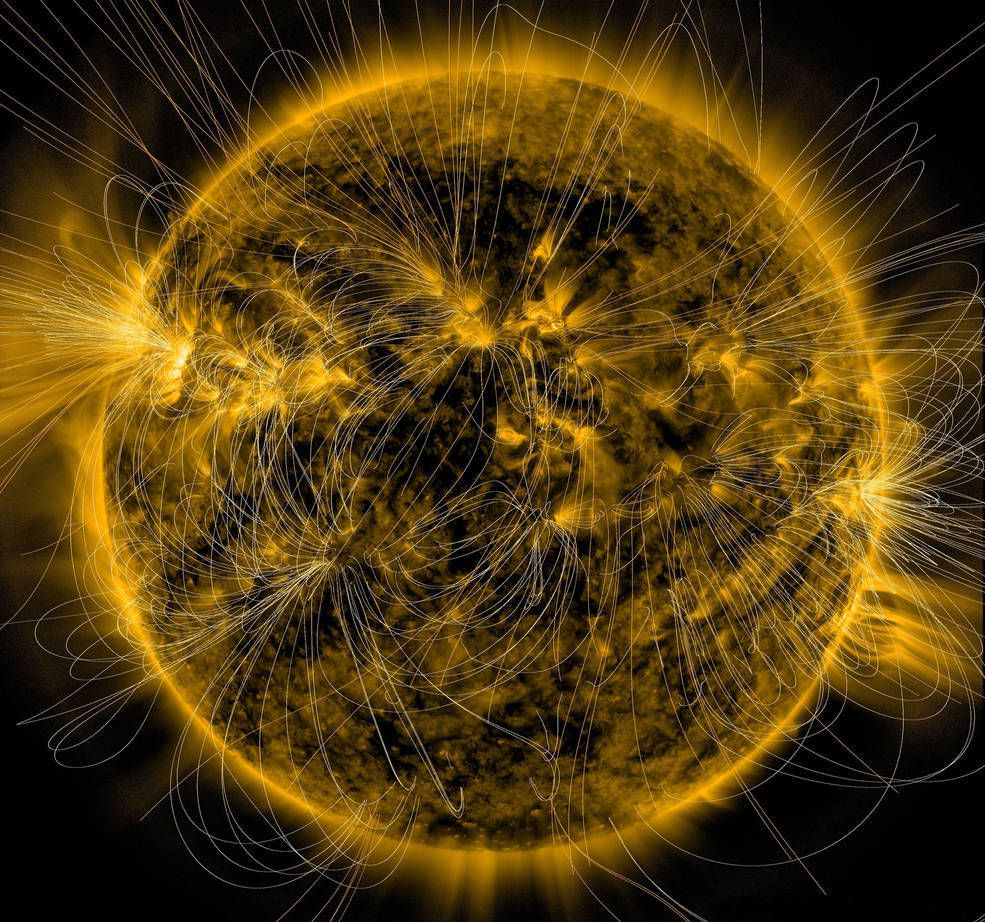
Heliophysics is the study of the heliosphere and the objects it interacts with. The Sun offers the unique opportunity to observe the behavior of a star in the universe. Sixty years ago, Eugene Parker published a groundbreaking paper on the Dynamics of interplanetary gases and magnetic fields. For the first time, at the age of 93, he witnessed last August the launch of the fastest spacecraft scheduled to arrive at its closest orbit to the Sun in 2024 to observe the magnetic fields coming out of the Sun and the gigantic coronal mass ejections. Will it explain why the temperature climbs as you move away from the surface of the Sun, as if the solar winds create insurmountable burning walls shying away from our reach? 

Earthrise

Consciousness, like a rumble rolling through the Universe, possesses free will because of the free "choices from quantum variables upward" (Stuart Kauffman, Humanity in a creative universe,  p.100). And when the Parker Solar Probe will be the closest to the Sun, will we observe up close what Matloff calls "stellar consciousness"? Is the Sun expressing its "stellar volition" when electromagnetic bursts are unwinding in space?  


Through the Hubble Ultra-Deep Field we gaze at 10,000 galaxies and an approximate 100 billion stars. Billions and billions of planets are hidden in the landscape. Is the Universe a product of Consciousness, or is Consciousness a fool to think that the Universe is real? One might wonder whether there is a multiverse and if there is, do all the possible universes coexist with all the possible consciousnesses? Does time-space extend through layers and layers of universes, or does each universe possess its own sense of time and space?  

NASA-HS201427a-HubbleUltraDeepField2014-20140603

“...we can consider the idea that the superpositions of different space-times, one per pathway, are different possible space-times! ...What if time flowing in the Possible is imaginary time?”

Stuart Kauffman, Humanity in a Creative Universe, p.214

Stuart Kauffman talks about the two concepts of res potentia and res extensa.  Werner Heisenberg pointed out that the old concept of (res) potentiaintroduced something standing in the middle between the idea of an event and the actual event, a strange kind of physical reality just in the middle between possibility and reality”. Res extensa originally would refer to what Descartes called substance corporelle (corporeal substance) which I would understand as the manifestation of the thing itself.  

If possibles are outside of space but inside of time, res potentia can have existed before the Big Bang, opening new ways to think about the origin of the universe

Stuart Kauffman, Humanity in a Creative Universe, p.125

When I read about quantum physics, I struggle to wrap my head around all the concepts. It is a learning process that nurtures my imagination. Following up on the idea of a free-willed consciousness – a pampsychism as described by David Chalmers and Thomas Nagel, when Kauffman proposed that conscious and free-willed observation is necessary and sufficient for measurement, it reminds me of what Alva Noë wrote that Consciousness derives from interactions with the physical environment. Carlo Rovelli also mentioned that time is the form in which every physical object interacts with the Universe, the source of our identity. Isn't what can be defined as a conscious feeling of time


If time is an illusion, Consciousness is a fool bumping its head. It is an infinitely resourceful kinetic energy, and the Universe is its receptacle. Some believe that human beings are the raison d'être of the Universe and defend the Anthropic Cosmological Principle along the line of "I think; therefore, the Universe exists." But is our own point of view  “central to the universe? We are an episode in a biological process, a by-product in the myriad of universal possibilities, an accidental outcome, just an episode in time.

We're left with no choice but to accept that our presence as an observer, and how we make the observation, physically changes what we're looking at.

Robert Lanza, Beyond Biocentrism, p.52-53

On the nature of physical reality

Published on by Catherine Toulsaly


Starting to look like I can’t write both texts at the same time and I can’t translate my words in English, for there is, I am told, a Golden Rule of translation : Translators only translate into their native language. It might not be true for everybody but it sure looks like it’s true for me. In English I seem to write in a more matter-of-fact way. My words seem to lose the feel of poetry and the flow that I embrace in French. So it looks like my best bet at this point will be to write first the text in English and then to rewrite it in French for my other site. To be continued.


However here for a start the following article based on the French version posted on Nov.26 on resonanceouvanite.com.

Bird on a comb

Bird on a comb

The philosopher of the mind Paavo Pylkkänen explains that, when we speak of quantum ontology, it is to better indicate that at the base of quantum mechanics lies the possibility that a wave - like a physical thought, a metaphysical dust - operates mentally a particle of matter giving it shape and guiding its movement by the transmission of information. And if auto-similarity is the principle governing an unlimited number of spatio-temporal structures, is it not self-evident that a body made of this kind of aggregate is inhabited by a “mind that guides it”?  


Inside the cosmic prison, an infinite number of superposed states collapse  - in the framework of an integrated information theory - causing consciousness to emerge in the quantum universe of elementary dust of which the universe is made. Imagine that the universe is a brain. A black hole is a loss of memory, a white hole a source of ideas that spring up. The nebulous gas from which stars are born is the state of confusion that precedes clarity. As it is for our DNA that goes back in time and space so travels consciousness in a universe of waves and vibrations.

In the shadows of the mind lies the problem posed by the nature of physical reality. The physicist Lev Vaidman asserts that there are infinitely many parallel worlds similar to the one we know, all incorporated into a single quantum state of the universe. These parallel worlds have no effect on ours. Although they can produce interference, we are not able to measure their effects. What he means, I think, is that if we can trace past events in our world and give them meaning, the future consists of an infinite number of multiple worlds.

A quantum state represents a set of statements about the probabilities for the outcomes of measurements that can be explained in the framework of any interpretation of quantum mechanics.

Lev Vaidman

Information, descriptive of a set of data, is embedded from a particle into a system, from an individual into a group, from stars into galaxies to the entire universe. The nature of physical reality depends on its observation and, consequently, on the ontology of consciousness, for if consciousness is to be conceptualized in the framework of an integrated information theory, is its foundation physical or non-physical?


In the most palpable way in our daily life, the nature of physical reality involves time. Yet the theorist Emily Adlam says that the temporal locality is a dogma that it is time to bring down. Although the principle of quantum entanglement, namely the principle of spatial non-locality, is accepted today, the question of temporal locality hasn't been much debated, that is to say that one agrees generally that probabilities related to the measurements observed at a given time depend exclusively on the state considered at that given moment. In fact, the temporal locality remains at a very least an essential methodological principle in our conception of science and in what we admit to being a reasoned scientific hypothesis. It is deeply rooted in the foundations of the interpretation we give to quantum mechanics. Unraveling the inextricable links woven between temporal locality and quantum theory may undermine gravely its meaning.


The two-state vector formalism introduced 54 years ago transcribes into the language of mathematics a vision of the world that seeks to render intelligible a set of observations. It suggests the paradox that the past and the future play an equal role in the determination of the quantum state at the intermediate points and are therefore “equally real”, according to the paper written by Yakir Aharonov, Eliahu Cohen et Tomer Landsberger . The theory of double causality is articulated like a passage in which time and the reversal of time produce the observation of an “element of reality”. The authors are inclined to think that nature is trying to clue in a fundamental truth, namely that quantum mechanics is unique in the sense that it sets the final and non-redundant boundary conditions of all systems. In other words, the final boundary conditions of transition states between microscopic and macroscopic physics play a key role in the interpretation of quantum mechanics, especially in cosmology and black hole physics.


At the junction between past and future lies the present as if in their determination to meet, the past had traveled the same distance as the future backwards. Can we transpose into our physical reality the principle of two quantum states, one of which evolves backwards and the other forward? Can the future as if it were written have an impact on the present? After all, if quantum theory does not describe the world as we live it, what is it for?  


The nature of physical reality involves the reality of the self. Consciousness walks the roads of the future and the paths of the past. In a state of unconsciousness, have I had the foreknowledge of my future that is taking me on this journey today? A translator is like an actor who identifies with the roles he plays. Have I in the past identified too much with the Buddhist works I translated? We tend to think that we are what we do and others think that they know who we are based on what we do but we are not what we do. I am not the autobiographical self. Driven by a burning desire to meet Truth, the poet pursues its exploration thousands of light-years away in search of new ways of thinking and draws from the wisdom of others' grains of madness. But beyond the scientific implications, the nature of physical reality rests upon a more basic level, our own emotions.


Alex Honnold is a solo climber. The Medical University of South Carolina, in Charleston, wanted to study his cerebral activity with the help of a “functional magnetic resonance imaging (fMRI) brain scanner”. The findings of the study showed a minimal activity of his amygdala that acts like the “center of a threat response and interpretation system”. Although it is difficult to determine how much of his ability to control his fears is from birth after 15 years of escalation, Joseph LeDoux, a neuroscientist at New York University, believes that Alex Honnold has probably always shown some emotional restraint, reinforced by thousands of hours taking risks as part of his daily routine. His ability to focus on the present allows him to see the reality of the moment without the veil of his apprehensions.

Consciousness and the Universe

Published on by Catherine Toulsaly

How do we perceive the link between the Universe in which we all live and Consciousness that we all share?  


This blog will be in English, a change from a blog that I carried thru for the past 8 years at resonanceouvanite.com but since a lot of my sources are in English, it comes as a natural decision from now on that I write on the subject in English. Based on my schedule, I’ll try to post an article every two weeks more or less.


I will need at first to figure out what's the best approach moving forward: should I work in French and then rewrite the text in English? Write both texts at the same time? Or should I simply use this blog as a notepad that gathers the different quotes and sources?


I  also will need to strike the right balance between the academic rigor needed for my articles in English and my own sense of poetry. That is the hardest part to not let the poet’s mind run wild. As the English poet John Keats wrote “Beauty is truth, truth beauty”, which I take less as an assessment of reality and more as a guiding principle that I, an individual, and humanity, as a whole, pursue.


I wish this blog to be limited in scope on the link between the Universe and Consciousness. I struggled to find the right fit for the domain name.  consciousnessanduniverse.com, though too long, has the benefit to be self-explanatory. I tossed around a few ideas like sharedconsciousness or shareduniverse. Neither seems to emphasize an important point for me: a focus on the relation between Consciousness and the Universe, that is turned to the future.  


Frankly, I am not sure whether this blog will fly given the extra work that it entails but I thought I’ll give it a shot. Give it a year. Writing in English for me is one more challenge that I want to take on and if anyone wishes to share their own thoughts in a post on the relation between Consciousness and the Universe, let me know. Based on what I started to do with resonanceouvanite.com, there is I believe a lot that can be said.  


The way that I write usually goes like this : I ask a lot of questions that might remain unanswered and put forward statements that might be unsettling at first. This is the way to move forward in order to find some answers and challenge a few dogmas along the way.


I dare to say that I believe philosophy is not dead. It is there to explain the unexplained and the mathematical riddles crafted by scientists. I prefer poetry because poets are playful and irreverent, unaware of boundaries. I also came into the realization that I do not believe in a self after writing on the subject lately, thanks to Thomas Metzinger. What I believe in is consciousness filling space and time, physically inhabiting us.


With time I will sort out my earlier articles in French in order to pick the most relevant materials for further study and post some excerpts in English.


On my ongoing quest for authenticity, I will not sign this blog with my pen name Ysia but with my real name Catherine Toulsaly.

<< < 10 11 12 13